
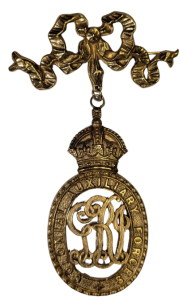
Colonel Harry F. McLeod (1871–1921) Colonial Auxiliary Forces Officers’ Decoration Obverse (front) Gift of Mark Lukin Collection of the Fredericton Region Museum 2026.31.1
This year, the York-Sunbury Historical Society is remembering Colonel Harry Fulton McLeod (MacLeod), a man whose life of public service extended from the political arena to the military. Like many other casualties of the First World War, McLeod died not from wounds sustained on the battlefield, but from illness. Unlike many, however, he had returned home to Canada before succumbing to his illness. Although his death was ultimately attributed to his war service, his name does not appear in the Books of Remembrance in Ottawa. This is because he died after his formal release from the Canadian Expeditionary Force (CEF).
Today, our tangible connection to McLeod is his Colonial Auxiliary Forces Officers’ Decoration (CAFOD), inscribed with his name and regiment: Colonel H.F. McLeod, 71st Regiment. The decoration was awarded in recognition of twenty years of long and distinguished service. Now modified to be worn as a brooch, likely by his wife or one of his daughters, it remains a personal reminder of a man whose military service and ultimate sacrifice deserve to be remembered.
Harry Fulton McLeod (also recorded as MacLeod) was born on 13 September 1871, the son of Reverend Joseph McLeod and Jane Fulton Squires. He grew up in Fredericton and earned a Bachelor of Arts degree from the University of New Brunswick in 1891. He then articled in law and was admitted to the Bar in 1895. His legal career progressed, and in 1910 he was appointed King’s Counsel (KC). Alongside his legal practice, McLeod developed an active career in public life. He served as Mayor of Fredericton from 1907 to 1908, was a member of the New Brunswick Legislative Assembly from 1908 to 1913, and was elected as a Conservative Member of Parliament in 1913. He also served in the House of Commons until 1921.
On 30 December 1908, McLeod married Ina Florence Mersereau. They had three children: a son, Norman McDonald, and two daughters, Jean York and Mary. Outside his professional and political commitments, McLeod was involved in several community organisations, including the Orange Lodge and the Fredericton Society of St. Andrews.
McLeod began his military career in 1895 with the 71st Battalion, York Regiment. His advancement through the ranks was relatively rapid. He was promoted to Captain in 1899, Major in 1906 and Lieutenant-Colonel in 1909, when he was appointed Commanding Officer of the regiment. With the outbreak of the First World War in August 1914, McLeod travelled to Camp Valcartier, near Quebec City, where Canada’s First Contingent was assembling. He was appointed Commanding Officer of the 12th Battalion, Canadian Expeditionary Force, and sailed with the battalion for England on 1 October 1914. For reasons that are not clear, McLeod re-attested into the CEF at Sling Camp, England, on 23 December 1914. On 17 January 1915, the 12th Battalion became part of the Canadian Training Depot. It was subsequently reorganised as the 12th Canadian Reserve Battalion on 4 January 1917. McLeod continued to serve as Commanding Officer of the 12th Battalion during its time in England.
His time overseas was marked by repeated bouts of serious illness, particularly pneumonia. In January 1915, he contracted pneumonia but recovered sufficiently to continue his duties. On 5 June 1915, he was sent to France, on command, to No. 3 General Base Depot at Havre. He returned to England on 17 July. Although his time in France was relatively brief, it qualified him for the 1914–15 Star. This medal, together with the British War Medal and the Victory Medal, formed his First World War medal trio.
In December 1915, McLeod was again seriously ill with pneumonia, although once more he recovered. His military responsibilities continued to grow, and on 22 May 1916 he was appointed Temporary Colonel. He resumed command of the 12th Battalion on 30 May.
On 21 December 1916, McLeod was transferred to the General List and appointed Colonel, Divisional Troops, Headquarters. Later that month, however, he suffered another serious attack of pneumonia and was reported as seriously ill. Following his recovery, he was returned to the strength of the 12th Battalion on 21 April 1917.
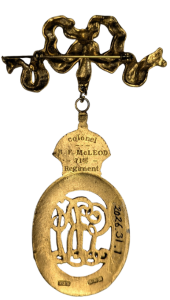
Colonel Harry F. McLeod (1871–1921) Colonial Auxiliary Forces Officers’ Decoration Reverse (back), inscribed: “Colonel H.F. McLeod, 71st Regiment” Gift of Mark Lukin Collection of the Fredericton Region Museum 2026.31.1
His return to duty was short-lived. On 9 June 1917, a Medical Board determined that he was unfit for further active service. He subsequently returned to Canada, arriving on 12 July 1917. At some point during 1917, he was awarded the Colonial Auxiliary Forces Officers’ Decoration in recognition of his long service with the 71st Regiment. Even after returning to Canada, his health remained fragile. In September 1917, he was hospitalised in Ottawa with influenza.
Following his return to Canada, McLeod resumed his duties as the Member of Parliament for York. However, the illnesses he had suffered overseas continued to affect his health. On 7 January 1921, he died of pneumonia in Fredericton, aged 49, and was buried at Forest Hill Cemetery in Fredericton. His death was officially deemed attributable to his military service during the First World War.
Although McLeod had been released from the CEF before his death, the recognition of his passing as war-related meant that his family received the customary posthumous memorial items. His widow was sent a Memorial Plaque, Memorial Scroll and Memorial Cross. His son received his father’s war medals: the 1914–15 Star, the British War Medal and the Victory Medal. These were forwarded to the family on 6 April 1922.
The present whereabouts of his First World War medals, Memorial Plaque, Memorial Scroll and Memorial Cross are unknown. His Colonial Auxiliary Forces Officers’ Decoration, however, has found its way into the collection of the York-Sunbury Historical Society. At some point, it was modified to be worn as a brooch, likely by his wife or one of his daughters. This alteration gives the decoration a more personal dimension, transforming a military award into a family keepsake.
Today, this small but significant object provides a tangible link to Colonel Harry Fulton McLeod and his years of service. His story also reminds us that the human cost of the First World War extended far beyond the battlefield. Many men returned home carrying the effects of illnesses contracted during their service, and some, like McLeod, eventually lost their lives as a result.
His name may not appear in the Books of Remembrance in Ottawa, but his service and sacrifice should not be forgotten. Through the preservation of his decoration and the telling of his story, we can continue to remember Colonel Harry Fulton McLeod and all those who gave their lives for their country, whether on the battlefield or at home.
By Major (Retired) Gary Campbell, CD, PhD
York-Sunbury Historical Society
For more information, please contact:
Alena Krasnikova, Executive Director
Fredericton Region Museum www.frederictonregionmuseum.com
Email: frederictonregionmuseum@gmail.com or phone 506-455-6041






Leave A Comment